


Conventional Appraisals Still Have Property Condition Requirements
Why Conventional Appraisals Can Still Require Repairs
Many real estate agents believe conventional loans don’t have property condition requirements because they aren’t subject to FHA’s Minimum Property Requirements (MPRs). While conventional financing generally offers more flexibility than FHA, that doesn’t mean the appraiser ignores the condition of the home. In fact, every conventional appraisal includes a detailed evaluation of the property’s overall condition.
The appraiser assigns a condition rating, evaluates the home’s safety, soundness, structural integrity, and overall marketability, and determines whether any deficiencies could affect the property’s value or the lender’s collateral. In some situations, a conventional appraisal may even be completed subject to repairs before the loan can close.
Understanding how conventional appraisers evaluate property condition can help Realtors better prepare listings, set realistic expectations for buyers and sellers, and avoid unexpected appraisal issues that delay or even derail a transaction. Whether you’re representing the buyer or the seller, knowing what appraisers look for can make the closing process much smoother.
The Biggest Myth About Conventional Appraisals
Myth: Conventional loans don’t have property condition requirements.
This is one of the most common misconceptions in real estate, and it’s easy to understand why. Unlike FHA loans, conventional financing isn’t governed by HUD’s Minimum Property Requirements (MPRs). Over time, many agents have interpreted that to mean conventional appraisals are simply concerned with value and don’t pay much attention to the home’s condition.
The reality is very different.
Every conventional appraisal includes an evaluation of the property’s overall condition. The appraiser doesn’t just determine what the home is worth—they also assess its physical condition, compare it to competing properties in the market, and identify any deficiencies that could affect the lender’s collateral.
Property condition can influence much more than whether a loan is approved. It can affect:
- The home’s appraised value.
- Which comparable sales the appraiser selects.
- Adjustments made to those comparable sales.
- The property’s overall marketability.
- Whether repairs are required before the loan can close.
The difference is that conventional appraisals don’t follow the same checklist as FHA appraisals. Instead of asking whether a property meets HUD’s Minimum Property Requirements, the appraiser evaluates whether the home’s condition presents concerns that affect its safety, structural integrity, marketability, or value.
Understanding that distinction is the key to avoiding one of the biggest surprises Realtors encounter during the appraisal process.
Every Conventional Appraisal Includes a Condition Rating
Every conventional appraisal includes more than an opinion of value. The appraiser also evaluates the home’s overall physical condition using Fannie Mae’s standardized C1 through C6 condition rating scale. This rating helps communicate how the property compares to similar homes in the local market and plays an important role in selecting comparable sales, determining adjustments, and evaluating the home’s overall marketability.
Rather than asking whether a home is simply “good” or “bad,” the appraiser assigns a condition rating based on its observable physical condition, level of maintenance, and any deferred repairs.
Think of the C1 through C6 scale as a common language that allows appraisers, lenders, and underwriters to consistently describe a home’s condition.
Understanding the C1 Through C6 Condition Ratings
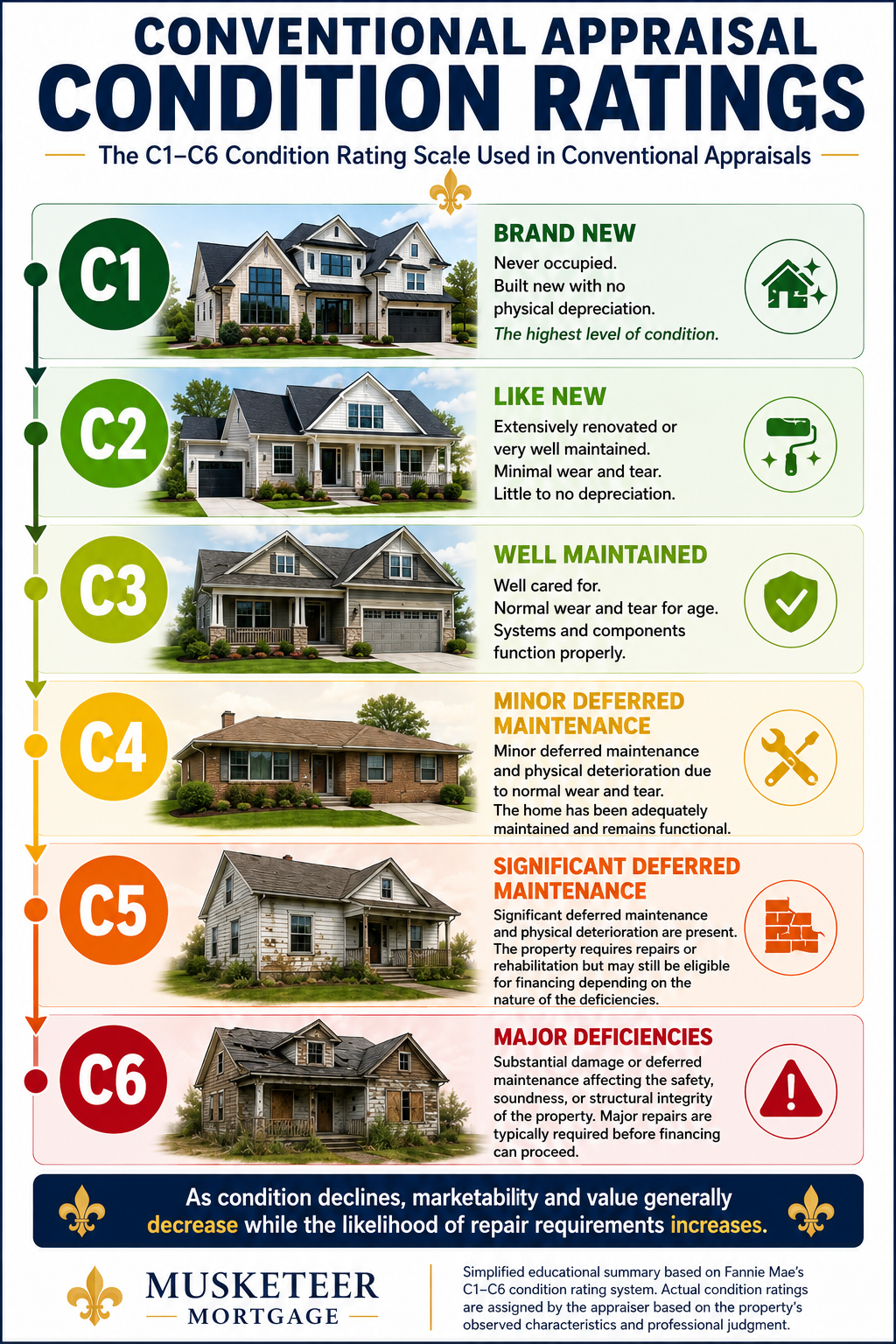
Important: Condition ratings are assigned by the appraiser using professional judgment based on the property’s observed characteristics. The examples below are educational and are intended to help explain the general purpose of each condition rating.
C1 – Brand New Construction
A C1 property is a newly constructed home that has never been occupied and has no signs of physical depreciation. Because the home has not been lived in, all components and finishes are considered new, and there are no observable deficiencies or deferred maintenance.
C1 properties are relatively uncommon outside of new construction developments. Even a home that is only a few years old is typically no longer considered C1 because some degree of normal physical depreciation has occurred.
C2 – Like New
A C2 property has experienced no significant physical depreciation and has no deferred maintenance. While it may have been previously occupied, the home has either been exceptionally well maintained or extensively renovated so that it closely resembles new construction.
A C2 rating is reserved for properties that require virtually no repairs or updates and exhibit little or no wear. Most resale homes, even those in excellent condition, do not receive a C2 rating.
C3 – Well Maintained
A C3 property is well maintained and exhibits only normal physical deterioration associated with its age. Any wear and tear is considered typical, and there are no significant deferred maintenance items affecting the property’s overall condition.
This is one of the most misunderstood condition ratings. Many homeowners believe their property qualifies as C2 simply because it has been well cared for. In reality, most well-maintained resale homes fall into the C3 category.
Examples may include:
- A roof with normal remaining life.
- Mechanicals functioning as intended.
- Minor cosmetic wear consistent with the home’s age.
- Updated or original finishes that remain in good working order.
A C3 home does not have to be recently remodeled. It simply reflects a property that has been properly maintained over time.
C4 – Minor Deferred Maintenance
A C4 property has experienced minor deferred maintenance and physical deterioration due to normal wear and tear. While some components may be approaching the end of their economic life, the home remains adequately maintained, functional, and generally acceptable for financing.
Examples may include:
- Worn flooring or carpeting.
- Aging paint finishes.
- Older kitchens or bathrooms that remain functional.
- Minor maintenance items that have accumulated over time.
A C4 rating does not mean the property is in poor condition. In fact, many owner-occupied homes receive a C4 rating and remain fully eligible for conventional financing.
C5 – Significant Deferred Maintenance
A C5 property exhibits significant deferred maintenance, physical deterioration, or both. Repairs or rehabilitation are needed, and the property’s overall condition is noticeably inferior to well-maintained competing homes.
Examples may include:
- Roof nearing failure.
- Significant wood rot.
- Damaged flooring.
- Water intrusion.
- Broken windows.
- Mechanical systems in poor condition.
Although a C5 property requires repairs, it is not automatically ineligible for conventional financing. Eligibility depends on the nature and severity of the deficiencies, as well as whether they affect the lender’s collateral or the property’s safety, soundness, or structural integrity.
C6 – Major Deficiencies
A C6 property has substantial damage or deferred maintenance that significantly affects the property’s safety, soundness, or structural integrity. These deficiencies are severe enough that major repairs are generally necessary before the home will meet conventional lending requirements.
Examples may include:
- Structural failure.
- Significant foundation movement.
- Major roof failure.
- Fire damage.
- Extensive water damage.
- Unsafe electrical systems.
- Conditions that make portions of the home uninhabitable.
A C6 property typically requires repairs before the loan can close. The appraiser will often complete the appraisal subject to repairs, allowing the lender to verify that the deficiencies have been corrected before final approval.
What Repairs Can a Conventional Appraisal Require?
One of the biggest misconceptions about conventional financing is that the appraiser only cares about the home’s value. In reality, conventional appraisers are also responsible for identifying conditions that could affect the lender’s collateral.
The key distinction is this: conventional appraisals generally focus on whether a property’s condition affects its safety, soundness, structural integrity, or overall marketability—not whether the home is simply outdated or unattractive.
While every appraisal is unique, the following examples illustrate the types of conditions that are typically cosmetic versus those that may require repairs before a loan can close.
Usually Cosmetic (Not Typically a Repair Issue)
These items may affect a home’s value or condition rating but do not normally require repairs simply because they are present.
- Worn carpeting or flooring
- Dated paint colors or wallpaper
- Older kitchen cabinets
- Laminate or aging countertops
- Cosmetic drywall imperfections
- Older but functional appliances
- Outdated light fixtures
- Normal wear and tear consistent with the home’s age
These conditions often influence the property’s C1–C6 condition rating or appraised value but generally do not prevent a conventional loan from closing.
Conditions That May Require Repairs
The following issues receive much closer attention because they may affect the property’s safety, structural integrity, habitability, or the lender’s collateral.
Examples include:
- Active roof leaks
- Exposed electrical wiring
- Significant structural damage
- Unsafe or missing handrails where a safety hazard exists
- Broken windows affecting security or weather resistance
- Significant water intrusion
- Foundation movement or structural settlement
- Missing or inoperable mechanical systems
- Conditions creating health or safety hazards
Depending on the severity of these deficiencies, the appraiser may complete the appraisal subject to repairs, allowing the lender to verify that the issues have been corrected before the loan can close.
It’s Not About Cosmetics—It’s About Risk
One of the easiest ways to understand conventional appraisal requirements is to ask a simple question:
Does this condition simply affect the home’s appearance, or does it affect the lender’s collateral?
Minor cosmetic issues usually influence value or the home’s overall condition rating. More serious deficiencies may affect:
- Safety – Could someone reasonably be injured?
- Soundness – Does the home function as intended?
- Structural Integrity – Is the home’s structure compromised?
- Marketability – Could these issues significantly reduce the property’s ability to compete in the local market?
The more a condition impacts these factors, the more likely it is that repairs will be required before the lender can finalize the loan.
Condition Affects More Than Loan Approval
Many buyers and even experienced real estate agents think a property’s condition only becomes important if it causes the loan to be denied or repairs to be required. In reality, a home’s condition influences nearly every part of the appraisal process long before the lender decides whether the loan is acceptable.
The appraiser’s opinion of condition helps shape the entire valuation analysis, from the comparable sales selected to the final opinion of market value. Even when no repairs are required, a property’s condition can significantly affect the appraised value and, ultimately, whether the transaction moves forward as planned.
Property condition can influence:
Comparable Sale Selection
Appraisers strive to compare homes with similar overall condition. A C4 property should generally be compared to other homes with similar levels of maintenance and physical condition rather than extensively renovated homes. Selecting comparable properties with significantly different condition ratings often requires larger adjustments.
Condition Adjustments
When comparable sales differ in condition, the appraiser may apply market-supported adjustments to account for those differences. For example, a recently renovated home may command a higher market value than an otherwise similar property with dated finishes or deferred maintenance.
Appraised Value
Condition directly affects how buyers perceive a property’s desirability, and those market reactions are reflected in comparable sales. Better-maintained homes frequently sell for more than similar properties requiring updates or repairs, making condition an important component of the final opinion of value.
Lender Risk
Mortgage lenders rely on the appraisal to help determine whether the property provides adequate collateral for the loan. Homes with significant deferred maintenance or physical deficiencies may present greater risk because unexpected repairs or declining condition can reduce the property’s long-term value.
Future Marketability
Lenders also consider whether the property would remain marketable if they ever had to sell it following a foreclosure. While no one originates a loan expecting foreclosure, the property’s overall condition remains an important part of evaluating the quality of the collateral.
It’s About the Entire Picture
This is why conventional appraisals involve much more than determining whether repairs are required. The appraiser is evaluating the home’s overall condition, comparing it to competing properties in the market, assessing how that condition influences value, and helping the lender understand the quality of the collateral securing the loan.
For Realtors, understanding this broader purpose can help explain why seemingly minor differences in property condition sometimes result in meaningful differences in appraised value—even when both homes qualify for conventional financing.
Conventional vs. FHA Appraisal Requirements
One of the biggest misconceptions in real estate is that conventional appraisals “don’t care” about property condition while FHA appraisals do. The reality is that both appraisal types evaluate the condition of the home—they simply do so using different standards and for different purposes.
Neither approach is inherently better than the other. FHA places greater emphasis on meeting HUD’s Minimum Property Requirements (MPRs), while conventional appraisals focus on the property’s overall condition, marketability, and suitability as collateral for the loan.
| Conventional Appraisals | FHA Appraisals |
|---|---|
| Property condition influences value, comparable selection, and lender risk. | Property condition must meet HUD’s Minimum Property Requirements (MPRs). |
| Repairs may be required when deficiencies affect safety, soundness, structural integrity, or the lender’s collateral. | Repairs may be required to address conditions that do not meet HUD’s property standards. |
| Greater flexibility when evaluating cosmetic condition. | More prescriptive property condition standards. |
| Focuses primarily on market value and collateral risk. | Evaluates both market value and compliance with FHA property requirements. |
| Uses the C1–C6 condition rating system as part of the appraisal analysis. | Also uses the C1–C6 condition rating system while applying FHA property standards during the appraisal. |
Different Standards—Not Better or Worse
It’s important to remember that neither appraisal is “harder” or “easier.” They simply serve different purposes.
A home that qualifies for conventional financing may require repairs before it qualifies for FHA financing. Likewise, many well-maintained homes easily satisfy the requirements for both loan programs.
Understanding those differences allows Realtors to better prepare their clients, anticipate potential appraisal concerns, and choose the financing option that best fits both the borrower and the property.
Tips for Realtors Before the Appraisal
One of the best ways to avoid appraisal delays is to walk through the property before the appraiser arrives and look at it through the eyes of a lender—not just a buyer. Most conventional appraisals don’t require repairs, but identifying obvious concerns ahead of time can prevent last-minute surprises that delay closing.
Before the appraisal appointment, consider the following:
- Address obvious safety hazards. Repair loose steps, unstable decks, broken handrails, exposed wiring, or other conditions that could present a safety concern.
- Fix active roof leaks and water intrusion. Water damage often leads to additional concerns, including damaged drywall, mold, or structural deterioration.
- Ensure all major systems are operational. Heating, electrical, plumbing, and other major mechanical systems should be functioning as intended on the day of the appraisal.
- Replace broken windows or damaged exterior doors. Security and weather resistance can become appraisal concerns if these items are compromised.
- Provide safe access to all areas of the home. Appraisers typically need access to every room, the attic (when accessible), the crawl space or basement, and the garage.
- Prepare a list of recent improvements. New roofs, HVAC systems, remodeling projects, windows, flooring, or other significant updates may help the appraiser better understand the property’s overall condition.
- Have permits or documentation available when appropriate. If major renovations or additions were completed, supporting documentation may answer questions before they become conditions.
- Don’t worry about cosmetic imperfections. Dated finishes, older cabinets, worn carpet, or outdated paint colors rarely require repairs on a conventional loan unless they accompany larger property condition concerns.
- Understand that cleanliness isn’t the same as condition. A spotless home creates a great impression, but appraisers are evaluating the property’s physical condition—not housekeeping.
- When in doubt, ask before listing. If you’re uncertain whether a condition could become an appraisal issue, consult with your preferred lender before putting the property under contract. A five-minute conversation today can prevent weeks of delays later.
A Little Preparation Goes a Long Way
Most conventional appraisals are straightforward and require no repairs at all. By identifying potential issues before the appraiser arrives and understanding how property condition influences the appraisal process, Realtors can help transactions move more smoothly and set realistic expectations for both buyers and sellers.
Frequently Asked Questions
Yes. While conventional appraisals generally provide more flexibility than FHA appraisals, repairs may still be required when a property has deficiencies that affect its safety, soundness, structural integrity, or suitability as collateral for the loan. Cosmetic issues alone rarely require repairs, but significant property condition concerns may result in the appraisal being completed subject to repairs before closing.
A C4 condition rating indicates a home with minor deferred maintenance and physical deterioration due to normal wear and tear. The property remains adequately maintained and functional, but some components may show age or require routine maintenance. Many owner-occupied homes receive a C4 rating and remain fully eligible for conventional financing.
Yes, in many cases. A C5 property has significant deferred maintenance or physical deterioration, but that does not automatically make it ineligible for conventional financing. Eligibility depends on the type and severity of the deficiencies and whether they affect the lender’s collateral, safety, soundness, or structural integrity. Some C5 homes may require repairs before closing, while others may still qualify without additional work.
Both C3 and C4 properties are generally financeable, but a C3 home is well maintained with only normal wear and tear, while a C4 home exhibits minor deferred maintenance and more noticeable physical deterioration consistent with its age. The difference is often one of maintenance rather than age, and appraisers use professional judgment when assigning a condition rating.
Usually not by itself. Cosmetic paint issues generally affect the home’s overall condition rating rather than its financing eligibility. However, peeling paint combined with other signs of deferred maintenance or deterioration may contribute to a lower condition rating or additional appraisal concerns. Unlike FHA, conventional loans do not automatically require all peeling paint to be repaired simply because it is present.
A home does not technically “fail” a conventional appraisal. Instead, the appraiser provides an opinion of value and reports any property deficiencies that could affect the lender’s collateral. If significant safety, structural, or habitability concerns are identified, the lender may require repairs before approving the loan or determine that the property does not currently meet its lending requirements.
When an appraisal is completed subject to repairs, the appraiser has determined that specific deficiencies must be corrected before the property’s value opinion becomes effective for lending purposes. After the repairs are completed, the lender typically requests additional documentation or a final inspection confirming the required work has been finished.
The property’s condition rating is assigned by the licensed appraiser based on their professional judgment and observations during the inspection. Appraisers follow Fannie Mae’s condition rating definitions while considering the property’s overall maintenance, physical deterioration, deferred maintenance, and how it compares to similar homes in the local market.
No. Age alone does not determine a property’s condition rating. An older home that has been well maintained and updated may receive a higher condition rating than a newer home with significant deferred maintenance. Appraisers evaluate the property’s current physical condition—not simply the year it was built.
No. Conventional appraisals generally do not require cosmetic improvements such as replacing countertops, updating cabinets, installing new flooring, or repainting outdated colors. These items may influence the home’s value or condition rating, but they typically do not require repairs unless they are associated with broader property condition issues.
Conventional appraisers are not municipal code inspectors and do not perform code compliance inspections. However, if they observe obvious conditions that affect the property’s safety, soundness, structural integrity, or marketability, they are required to report those deficiencies in the appraisal. In some cases, those observed issues may lead to repair requirements before the loan can close.
Don't Let an Appraisal Surprise Delay Your Closing
Understanding how conventional appraisals evaluate property condition can help prevent unnecessary delays, reduce last-minute surprises, and give buyers and sellers more confidence throughout the transaction. Whether you’re a first-time homebuyer, an experienced homeowner, or a Realtor preparing a listing, knowing what appraisers look for allows you to identify potential concerns before they become closing issues.
At Musketeer Mortgage, we believe informed clients make better decisions. That’s why we take the time to explain appraisal requirements, answer questions before they become problems, and work closely with buyers, sellers, and real estate professionals throughout the financing process.
If you have questions about a property’s condition, an appraisal requirement, or whether a repair could affect financing, we’re always happy to help.
Contact Musketeer Mortgage today to discuss your next purchase, refinance, or appraisal question. We’d rather answer a five-minute question today than help solve a five-week problem tomorrow.
Call us Directly
Text us for a Quick Response