


Gift of Equity Calculator
Buying a Home from Family Doesn't Have to Be Complicated
If a parent, grandparent, or other close family member wants to sell you their home for less than its market value, you may be able to use the difference as your down payment through a Gift of Equity.
The challenge isn’t understanding the concept.
The challenge is structuring it correctly.
That’s where most families get stuck.
Almost every family asks the same questions:
- If Mom only wants $190,000, why would we write a contract for $230,000?
- Why does the loan amount sometimes go up?
- Does the required gift change if we finance the closing costs?
- Is this really legal?
- Are we doing something wrong if the contract is higher than what Mom wants?
This calculator removes the guesswork by showing exactly how each decision affects the loan amount, Gift of Equity, and Loan-to-Value (LTV).
Don’t worry—you don’t need to understand the math. That’s what the calculator is for. We’ll explain the “why” as you go.

What Is a Gift of Equity?
A Gift of Equity allows a family member to sell you a home for less than its current market value and use the difference as your down payment.
Instead of giving you cash for a down payment, they’re giving you part of the home’s equity.
For example:
- Home appraises for: $300,000
- Parent agrees to sell it for: $250,000
- Gift of Equity: $50,000
That $50,000 can often be used as your down payment, making it possible to buy the home with little or no money down, depending on the loan program.
Think of it this way…
Imagine your parents own a home worth $300,000, but they only want $250,000 for it.
They aren’t writing you a check for $50,000.
Instead, they’re simply giving you $50,000 of the home’s value.
That equity becomes part of your ownership in the home on the day you buy it.
Gift of Equity = Appraised Value − Sales Price
That’s the simple part.
The part that confuses most families is how the numbers change when closing costs are added to the loan.
That’s exactly why this calculator has two different scenarios—and we’ll walk through both.
When Can You Use One?
One of the biggest misconceptions about Gift of Equity transactions is that they can be used whenever someone wants to sell a home at a discount.
Unfortunately, that’s not how it works.
Most mortgage programs require the sale to occur between people who already have a close relationship. The purpose of the rule is to prevent buyers and sellers from artificially manipulating home values or disguising seller concessions as gifts.
The “Non-Arm’s Length” Rule
Mortgage guidelines refer to these transactions as non-arm’s length transactions.
That simply means the buyer and seller already have a close personal relationship before the sale.
Typical Gift of Equity relationships include:
✅ Almost Always Eligible
These relationships are commonly accepted by most mortgage programs:
- Parents
- Children
- Grandparents
- Grandchildren
- Brothers
- Sisters
- Adoptive parents and children
- Step-parents and step-children
- Legal guardians (when properly documented)
✅ Frequently Eligible (Depending on the Loan Program)
Many lenders and loan programs also allow:
- Aunts
- Uncles
- Nieces
- Nephews
- First cousins (loan product dependent)
- In-laws
- Former relatives (such as former in-laws in certain conventional situations)
- Godparents (under some conventional guidelines)
These are the types of transactions lenders generally expect to see when approving a Gift of Equity.
When a Gift of Equity Usually Isn’t Allowed
A Gift of Equity generally cannot be used between:
- ❌ Friends
- ❌ Neighbors
- ❌ Co-workers
- ❌ Investors
- ❌ Standard buyers and sellers
- ❌ Distant relatives who don’t meet lender requirements
Even if someone wants to “gift” part of the home’s value, mortgage guidelines usually won’t recognize it as a Gift of Equity unless the relationship qualifies.
One Important Thing to Remember
Every mortgage program defines “family” a little differently.
The relationship that qualifies for an FHA loan may not be identical to what’s allowed for a Conventional, VA, or USDA loan.
That’s okay.
If you’re wondering whether your relationship qualifies, the easiest solution is simply to ask. We can usually tell you in just a few minutes.
That’s why it’s always important to verify the guidelines before writing the purchase contract.
Why This Calculator Exists
Years ago, I became frustrated because Gift of Equity transactions were surprisingly difficult to explain—even to experienced loan officers.
Everyone understood the individual pieces. They understood appraised value, sales price, down payments, and closing costs. But when those pieces had to work together in a real transaction, the math suddenly became confusing. Families would leave conversations wondering why we were increasing the sales price, why the loan amount changed, or whether we were doing something wrong.
So I built a simple spreadsheet to let the math create the proper structure.
Instead of trying to visualize all of the moving pieces in my head, I let the spreadsheet do the thinking. In just a few seconds, it showed exactly how changing one number affected everything else. It quickly became the tool I used every time I structured a Gift of Equity purchase.
Then something unexpected happened.
After I recorded a YouTube video explaining Gift of Equity transactions, loan officers from across the country started calling and emailing me asking for a copy of the spreadsheet. I was happy to share what I’d learned, but eventually realized there was a better way.
So I turned that spreadsheet into this free calculator.
Now anyone—buyers, parents, grandparents, Realtors, and even other loan officers—can structure a Gift of Equity purchase in just a few seconds without having to build the spreadsheet themselves.
Today, this calculator has helped families and mortgage professionals across the country answer one simple question:
“How do we structure this correctly?”
And that’s exactly what it was built to do.
You don’t have to understand the math. Just enter the numbers, compare the two scenarios, and we’ll explain why the results change as you work through the page.
How To Use The Gift of Equity Calculator
Using the calculator is simple. Just enter the four numbers you know, and the calculator will instantly show you two different ways to structure the purchase.
You don’t need to understand the formulas—the calculator handles that for you. As you change the numbers, you’ll see how the loan amount, Loan-to-Value (LTV), and required Gift of Equity all adjust automatically.
Step 1: Enter the Seller’s Net Amount
How much does the seller want to receive at closing?
This is the amount the family member wants to walk away with after the sale.
For many families, this is the most important number because it’s the amount Mom, Dad, Grandma, or another relative has decided they want for the home.
Example: $190,000
Step 2: Enter the Home’s Estimated Value
What is the highest amount you believe the home will appraise for?
This is the home’s current market value—not the amount the seller wants.
You can estimate this using recent comparable sales, an online home value estimate, or a real estate professional. The final appraisal may be different, but this gives you a starting point.
Example: $230,000
Step 3: Estimate the Closing Costs
How much will the closing costs and prepaids be?
Include the estimated lender fees, title charges, escrow setup, prepaid taxes, homeowners insurance, and any other costs associated with closing the loan.
Don’t worry if it’s not exact. An estimate is all you need to compare the two scenarios.
Example: $8,000
Step 4: Enter the Sales Price
In many cases, the sales price is the same as the appraised value.
That surprises a lot of families.
Even if the seller only wants $190,000, it’s common to write the purchase contract for $230,000 because it allows the difference to become the Gift of Equity.
We’ll explain why that’s often beneficial later on this page.
Your Results
The calculator immediately compares two common ways to structure the transaction.
Option 1 – Finance the Closing Costs
The buyer finances the closing costs as part of the loan.
The calculator shows:
- Loan amount
- Loan-to-Value (LTV)
- Gift of Equity required
This option usually requires less cash at closing but results in a slightly larger loan.
Option 2 – Pay the Closing Costs Yourself
The buyer pays the closing costs out of pocket instead of financing them.
The calculator shows:
- Loan amount
- Loan-to-Value (LTV)
- Gift of Equity required
This option keeps the loan smaller but requires more cash at closing.
The Gift of Equity Calculator
Which Loan Programs Allow Gift of Equity?
The good news is that Gift of Equity purchases are available with many of today’s most popular mortgage programs.
While each loan type has its own documentation requirements and eligibility rules, the basic concept remains the same: a qualified family member sells the home below market value, and the difference becomes the buyer’s equity.
Here’s how the major loan programs compare.
| Loan Program | Gift of Equity Allowed? | Good Choice? | Notes |
|---|---|---|---|
| VA Loans | ✅ Yes | ⭐⭐⭐⭐⭐ | One of the most flexible programs. Qualified veterans may be able to purchase with little or no money out of pocket when enough equity is available. |
| FHA Loans | ✅ Yes | ⭐⭐⭐⭐⭐ | One of the most common loan programs used for Gift of Equity purchases. Excellent for buyers with smaller down payments or less-than-perfect credit. |
| Conventional Loans | ✅ Yes | ⭐⭐⭐⭐⭐ | Widely accepted for qualified family transactions and often offers lower mortgage insurance for well-qualified borrowers. |
| USDA Loans | ✅ In some situations | ⭐⭐⭐ | USDA loans may allow Gift of Equity transactions, but property eligibility and program requirements can make them less common. |
The Loan Program Doesn’t Usually Change the Concept
Whether you’re using an FHA, VA, Conventional, or USDA loan, the calculator on this page works the same way.
The math behind a Gift of Equity doesn’t change.
What does change are the underwriting guidelines, documentation requirements, and maximum financing allowed under each loan program.
That’s why this calculator focuses on helping you understand the structure first.
Once you know how the transaction should be structured, choosing the right loan program becomes much easier.
Learn More About Each Loan Program
If you’re still deciding which mortgage is right for your situation, we’ve created detailed guides for each program:
- VA Loans →
- FHA Loans →
- Conventional Loans →
- USDA Loans →
Gift of Equity vs Cash Gift
These two terms are often used interchangeably—but they aren’t the same thing.
A Gift of Equity uses the value that’s already built into the home.
A cash gift uses money that comes from someone’s bank account.
Understanding the difference can save a lot of confusion when you’re buying a home from a family member.
| Gift of Equity | Cash Gift |
|---|---|
| Comes from the home’s equity | Comes from cash in a bank account |
| No money changes hands for the gift itself | The donor transfers actual money to the buyer |
| Reduces or eliminates the down payment | Helps pay the down payment or closing costs |
| Usually requires a family relationship | May come from family or other approved sources depending on the loan program |
| Common when buying a home from parents or grandparents | Common when purchasing any home |
| Based on the difference between the appraised value and sales price | Based on the amount of money gifted |
Which One Is Better?
Neither is universally better. But a gift of equity can save the buyer a down payment, reduce mortgage insurance, potentially get a better rate when more equity is involved in the sale, and it can be structured in a way to help pay for closing costs.
A Gift of Equity is ideal when a family member wants to transfer part of the home’s value to the buyer.
A cash gift is helpful when additional funds are needed for the down payment, closing costs or prepaid expenses on a non-family member owned property.
The IRS Gift Tax: What Most Families Get Wrong
One of the first questions I hear from parents and grandparents is:
“If I give my child or grandchild part of my home’s equity, am I going to owe a huge gift tax?”
The good news is that, in most cases, the answer is no.
The Misconception
Many families believe that giving a Gift of Equity automatically creates a tax bill.
That’s understandable—but that’s usually not how the federal gift tax works.
The Reality
If the value of the Gift of Equity exceeds the IRS annual gift tax exclusion for the year of the transfer, the person giving the gift may be required to file IRS Form 709 (United States Gift Tax Return).
Filing a gift tax return does not automatically mean you owe gift tax.
In many situations, the amount simply counts against the giver’s lifetime federal gift and estate tax exemption, which is currently several million dollars. As a result, most families never actually pay federal gift tax on a Gift of Equity.
In other words:
- Filing a return and owing tax are not the same thing.
- Many Gift of Equity transactions require reporting, but not payment of gift tax.
- Every family’s tax situation is different, so it’s important to obtain professional tax advice before completing the transaction.
Why This Matters
Unfortunately, I’ve seen families walk away from perfectly legitimate Gift of Equity opportunities because they believed the IRS would immediately send them a tax bill.
In many cases, that simply isn’t true.
Understanding the difference between reporting a gift and paying gift tax can help families make informed decisions instead of acting out of fear.
⚠️ Important Tax Disclaimer
I am a mortgage loan officer—not a CPA, tax attorney, or financial advisor. The information on this page is intended to provide a general understanding of how Gift of Equity transactions are commonly handled and should not be considered tax advice.
Federal and state tax laws can change, and every family’s situation is unique. Before making any decisions involving gift taxes, IRS reporting requirements, or estate planning, you should consult a qualified CPA or tax professional.
Gift of Equity vs Down Payment
One of the most common misconceptions is that a Gift of Equity is the down payment.
That’s close—but it isn’t exactly true.
A down payment is the buyer’s required equity in the home at closing.
A Gift of Equity is one way to create that equity.
In many family transactions, the Gift of Equity satisfies all or part of the required down payment without the buyer bringing that money in cash.
Think of It Like This
Imagine a home appraises for $300,000.
A parent agrees to sell it for $250,000.
The difference—$50,000—becomes the Gift of Equity.
That $50,000 immediately becomes part of the buyer’s ownership in the home, which is why it can often satisfy the lender’s down payment requirement.
The buyer didn’t write a $50,000 check.
The equity already existed in the home.
It was simply transferred from the seller to the buyer through the purchase.
They Work Together—But They Aren’t the Same Thing
| Gift of Equity | Down Payment |
|---|---|
| Comes from the home’s equity | Represents the buyer’s required equity in the purchase |
| Created by selling below market value | Usually paid with cash, equity, or a combination of both |
| Reduces the amount of cash the buyer needs | Required by many loan programs |
| May satisfy all or part of the required down payment | Can come from personal savings, gift funds, or a Gift of Equity |
Can You Still Make a Down Payment?
Absolutely.
Some buyers choose to combine a Gift of Equity with their own cash down payment.
For example, a buyer might receive a $40,000 Gift of Equity and also contribute $10,000 of their own money toward the purchase.
The combination increases the buyer’s equity in the home and may reduce the loan amount even further.
Why This Confuses So Many Families
Most people picture a down payment as a cashier’s check brought to closing.
A Gift of Equity works differently.
Instead of bringing additional cash, the buyer starts with equity that already exists in the property because the seller agreed to sell the home for less than its market value.
That’s why you’ll often hear loan officers say the Gift of Equity is “used as the down payment.”
What they really mean is that the Gift of Equity creates the equity needed to satisfy the lender’s down payment requirement.
💡 Simple way to remember it:
A down payment tells the lender how much equity you have. A Gift of Equity is one way to create that equity without bringing cash to closing.
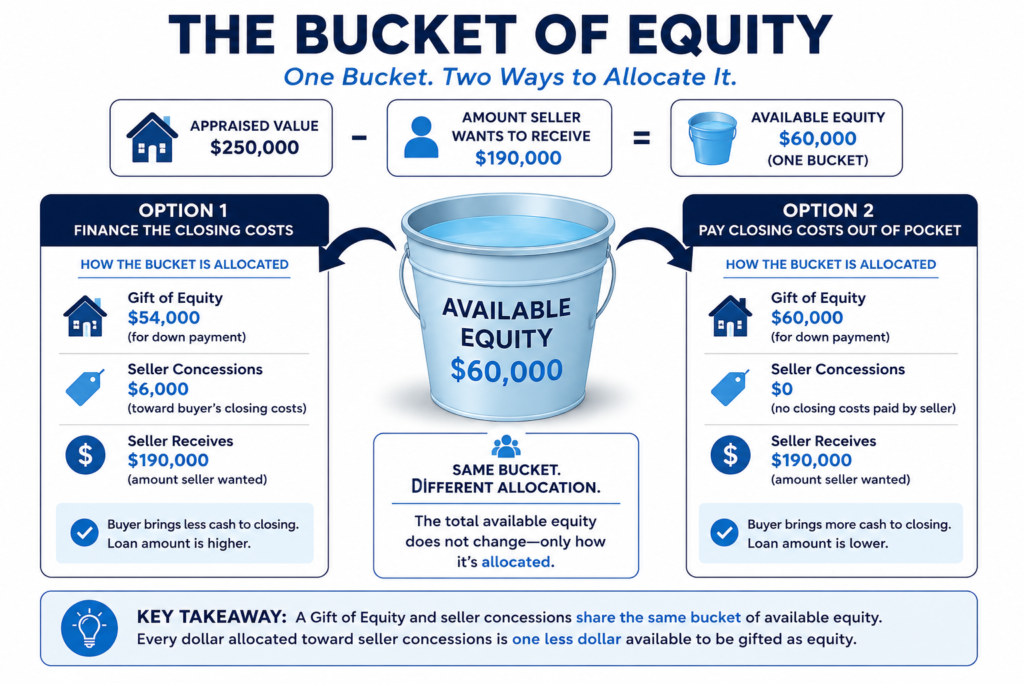
One Bucket. Two Ways to Use It.
Understanding Gift of Equity and Seller Concessions
One of the biggest misconceptions about a Gift of Equity transaction is that seller concessions create additional money.
They don’t.
Think of the home’s available equity as one bucket.
That bucket is simply the difference between what the home appraises for and what the seller chooses to walk away with at closing
Once that bucket exists, you simply decide how to allocate it.
Part of it can become a Gift of Equity to help satisfy the buyer’s down payment requirements.
Another part can be used as seller concessions to help pay the buyer’s eligible closing costs and prepaid expenses.
The important thing to understand is that both come from the same bucket of available equity.
There isn’t a separate bucket for the Gift of Equity and another bucket for seller concessions.
There is only one.
A Simple Example
Suppose a home appraises for $250,000, and Mom wants to walk away with $190,000.
That creates $60,000 of available equity.
Now you have choices.
You could use the entire $60,000 as a Gift of Equity.
Or…
You could allocate $54,000 as a Gift of Equity and $6,000 toward the buyer’s closing costs as seller concessions.
The total available equity is still $60,000.
You’ve simply allocated it differently.
Why This Confuses So Many Families
This is where many people believe something has gone wrong.
They see the Gift of Equity decrease from $60,000 to $54,000 and assume they’re “losing” $6,000.
They’re not.
That $6,000 wasn’t lost.
It was simply reallocated from one purpose to another.
Instead of helping with the buyer’s down payment, it’s now helping pay the buyer’s closing costs while still allowing the seller to receive the amount they wanted at closing.
Nothing disappeared.
The equity was simply used differently.
Why This Calculator Shows Two Scenarios
That’s why this calculator doesn’t just calculate a Gift of Equity.
It compares two different ways to allocate the same bucket of equity.
🏠 Option 1 – Finance the Closing Costs
- More of the available equity is allocated toward seller concessions.
- The Gift of Equity is smaller.
- The buyer brings less cash to closing.
💵 Option 2 – Pay Closing Costs Out of Pocket
- More of the available equity remains as a Gift of Equity.
- The loan amount is lower.
- The buyer pays the closing costs separately.
Neither option is automatically better.
They’re simply two different ways to structure the same transaction.
Key Takeaway
A Gift of Equity and seller concessions don’t compete with each other—they share the same bucket of available equity. Every dollar allocated toward seller concessions is one less dollar available to be gifted as equity. The total amount of available equity doesn’t change—only how it’s allocated.
Common Gift of Equity Mistakes
A Gift of Equity transaction isn’t difficult once you understand how the pieces fit together—but there are several mistakes that can completely change the numbers or even prevent the loan from being approved.
Here are the most common ones I see.
1. Forgetting About Closing Costs
This is probably the biggest mistake families make.
Many buyers want to bring little or no money to closing, so they ask the seller to pay the closing costs.
The problem is those seller concessions come from the same bucket of available equity.
If you don’t account for closing costs when structuring the transaction, the Gift of Equity may not be large enough to accomplish both goals.
That’s why this calculator shows both scenarios.
2. Assuming the Sales Price Should Equal What the Seller Wants
This confuses almost every family.
If Mom wants to receive $190,000, that does not necessarily mean the purchase contract should be written for $190,000.
In many cases, the sales price is intentionally written at the appraised value to maximize the available equity while still allowing Mom to walk away with exactly what she wanted.
The calculator helps you visualize why.
3. Ignoring Loan-to-Value (LTV)
Every loan program has maximum Loan-to-Value limits.
Even if enough equity exists, the loan still has to fit within the lender’s LTV guidelines.
That’s why the calculator displays the LTV for each scenario.
4. Assuming Every Family Relationship Qualifies
Not every family transfer automatically qualifies for a Gift of Equity.
Most loan programs require the transaction to occur between eligible family members or other qualifying non-arm’s-length relationships.
If you’re unsure whether your relationship qualifies, ask your lender before signing a purchase contract.
5. Trying to Calculate Everything in Your Head
This is exactly why I built this calculator.
Gift of Equity transactions involve several moving parts:
- Appraised value
- Sales price
- Seller’s desired proceeds
- Closing costs
- Gift of Equity
- Loan amount
- Loan-to-Value
Change one number, and every other number changes with it.
The calculator does the math instantly so you can focus on making good decisions instead of trying to solve the puzzle on paper.
💡 Pro Tip: If you understand the Bucket of Equity concept, you’ve already solved the hardest part of structuring a Gift of Equity purchase. Everything else is simply deciding how to allocate that equity between the buyer’s down payment and any seller-paid closing costs.
Gift of Equity FAQS
A Gift of Equity allows a family member or other eligible relative to sell a home for less than its appraised value. The difference between the appraised value and the sales price becomes equity for the buyer instead of cash changing hands.
That equity can often satisfy all or part of the buyer’s required down payment, allowing them to purchase the home with little or no money down.
The basic formula is:
Gift of Equity = Appraised Value − Sales Price
However, if seller concessions are used to help pay closing costs, part of that available equity is reallocated toward those closing costs. That’s why this calculator shows two different scenarios.
This depends on the loan program.
Generally, Gifts of Equity are allowed between eligible family members and certain other non-arm’s-length relationships.
Examples often include:
- Parents
- Children
- Grandparents
- Grandchildren
- Brothers and sisters
- Aunts and uncles
- Nieces and nephews
- Step-relatives
- In-laws
- Domestic partners (when permitted)
Always verify eligibility with your lender because requirements vary by loan program.
Yes.
This is probably the most common Gift of Equity transaction.
Parents often sell the home below market value so their child can use the equity instead of cash for the required down payment.
Yes.
Grandparent-to-grandchild transfers are common and are generally permitted by most major loan programs.
Often, yes.
Many conventional loan programs recognize extended family relationships, although individual lender overlays may vary.
Always confirm with your lender before writing the purchase contract.
Yes.
The lender relies on the appraisal to determine the property’s market value.
Without the appraisal, there is no way to calculate the available equity for lending purposes.
Because the sales price and the seller’s proceeds are not always the same thing.
Many families choose a sales price equal to the appraised value because it creates the maximum amount of available equity.
The seller can still receive exactly the amount they wanted after the Gift of Equity is applied.
Because both come from the same pool of available equity.
Think of the available equity as one bucket.
You can allocate part of it toward the buyer’s down payment and part toward seller-paid closing costs—but every dollar used for one purpose is one less dollar available for the other.
Yes.
In fact, many successful Gift of Equity transactions use both.
The important part is structuring them correctly so the seller still receives the amount they want at closing.
No.
If structured correctly, the seller can still receive exactly the amount they wanted.
The calculator helps determine how to allocate the available equity to accomplish that goal.
Yes.
VA loans generally allow Gifts of Equity between eligible family members, subject to VA guidelines and lender requirements.
Yes.
FHA loans commonly allow Gifts of Equity for eligible family transactions.
The relationship between buyer and seller must satisfy FHA’s non-arm’s-length transaction requirements.
Yes.
Conventional loans also permit Gifts of Equity for qualifying family transactions, although specific eligibility rules may vary by lender.
In many cases, yes.
USDA loans can allow Gifts of Equity when the transaction meets USDA eligibility requirements and the relationship qualifies.
Usually, no immediate tax is owed simply because a Gift of Equity was given.
However, the seller may have IRS gift tax reporting requirements if the gift exceeds the annual exclusion amount.
This generally involves filing IRS Form 709 and often uses part of the lifetime gift tax exemption rather than creating an immediate tax bill.
Because every family’s tax situation is different, consult a qualified CPA or tax professional.
Sometimes.
If the resulting equity satisfies the lender’s minimum down payment requirements, it may eliminate or reduce the need for PMI on certain loan programs.
Yes.
Gift of Equity transactions are a well-established financing option recognized by FHA, VA, Conventional, USDA, and many other mortgage programs when structured properly.
Because changing just one number affects everything else.
Changing the sales price changes the Gift of Equity.
Changing closing costs changes how the available equity is allocated.
Changing the loan amount changes the Loan-to-Value ratio.
Rather than trying to calculate all of those moving parts yourself, this calculator shows both scenarios instantly and explains exactly why the numbers change.
Watch Me Build a Gift of Equity Transaction Step-by-Step
Prefer to watch instead?
If you’d rather see a real example than read through the details, this video walks through an actual Gift of Equity transaction step by step.
Need Help Building Your Gift of Equity?
Every family situation is a little different.
Maybe your parents want to walk away with a specific amount. Maybe you’re trying to buy the home with little or no money out of pocket. Maybe you’re wondering whether to finance the closing costs, how much equity is available, or even whether your family relationship qualifies.
You don’t have to figure it all out on your own.
I’ve helped families across the country structure Gift of Equity transactions that accomplish everyone’s goals while meeting lender guidelines. I’ll walk you through the numbers, explain every option in plain English, and help you build the structure that makes the most sense for your family.
Whether you’re buying from your parents, grandparents, an aunt or uncle, or another eligible family member, I’m happy to help.
Let’s Build Your Gift of Equity Together
If you are in KY, IN, FL, or MN and you’d like me to personally review your situation, simply reach out.
We’ll discuss:
- How much the seller wants to receive at closing
- How much equity is available
- Whether financing the closing costs makes sense
- Which loan program fits your situation
- The easiest way to structure everything before you write the purchase contract
There’s no obligation—just an opportunity to make sure you’re starting with the right structure.
Call us Directly
Text us for a Quick Response