

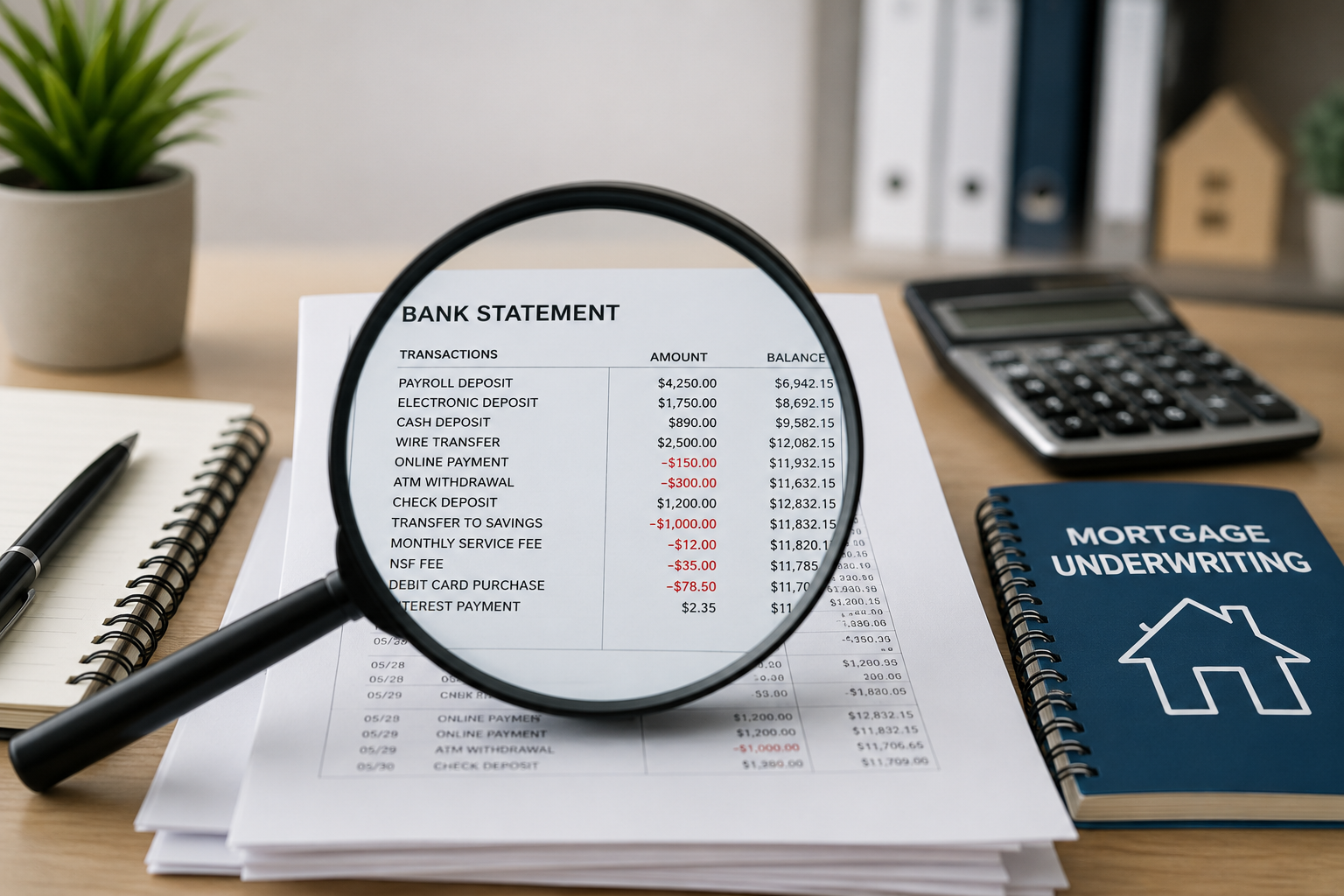
12 Things Mortgage Underwriters Look For on Your Bank Statements
Most borrowers assume mortgage underwriters are simply checking to see whether there’s enough money in the bank. In reality, they’re evaluating much more than your account balance. Every deposit, withdrawal, transfer, and overdraft helps tell the financial story behind your mortgage application.
Understanding what underwriters are looking for can help you avoid unnecessary conditions, prevent closing delays, and improve your chances of a smooth loan approval.
The good news is that underwriters aren’t looking for perfection—they’re looking for documentation, consistency, and financial stability.

The 12 Things Mortgage Underwriters Look For
1. Large Deposits
One of the first things a mortgage underwriter looks for is large deposits that don’t appear to come from your normal income. Mortgage guidelines generally require lenders to verify where significant funds came from if they’re being used to qualify for the loan or for your down payment and closing costs.
For example, selling a vehicle, receiving a gift from a family member, cashing out an investment account, or receiving a work bonus are all legitimate sources of funds. The underwriter simply needs documentation showing where the money originated.
The concern isn’t that you have extra money—it’s whether the funds represent undisclosed borrowed money that could affect your ability to repay the mortgage.
Quick Tip: If you expect a large deposit before closing, tell your loan officer before making it. It’s much easier to document the transaction upfront than after underwriting asks questions.
2. Overdrafts and NSF Fees
Overdrafts and non-sufficient funds (NSF) fees can indicate financial stress, so underwriters pay attention to recurring overdrafts on recent bank statements.
That doesn’t mean a single overdraft automatically hurts your loan. Most underwriters understand that isolated mistakes happen. What raises concern is a consistent pattern of overdrafts that suggests ongoing difficulty managing cash flow.
If overdrafts do appear, your loan officer may simply explain the circumstances or document that the issue has been resolved.
Remember: Underwriters are evaluating overall financial stability—not looking for perfection.
3. Payroll Deposits
Underwriters compare your payroll deposits to the income documented on your loan application.
They look for consistency between your pay stubs, W-2s, employment verification, and bank statements. Regular payroll deposits help confirm that the income being used to qualify is actually being received.
If your deposits vary because of overtime, commissions, bonuses, or seasonal employment, that isn’t necessarily a problem—it simply needs to match the documentation in your loan file.
4. Unusual Cash Deposits
Cash deposits often require additional explanation because cash generally cannot be independently traced after it’s deposited.
If several large cash deposits suddenly appear before closing, the underwriter may ask where the money came from and whether it can be used toward your mortgage transaction.
Whenever possible, avoid making large cash deposits while you’re in the mortgage process unless you’ve discussed them with your loan officer first.
5. Undisclosed Loans
Sometimes bank statements reveal monthly payments for personal loans that weren’t listed on the loan application.
Underwriters review recurring withdrawals to identify debts that may not appear on the credit report or that require additional explanation.
Their goal isn’t to catch borrowers making mistakes—it’s to ensure every ongoing financial obligation has been properly disclosed and evaluated.
6. Recurring Transfers
Frequent transfers between checking, savings, brokerage accounts, or other financial institutions are common and usually aren’t a concern.
However, underwriters often ask where transferred funds originated, especially if those funds are being used for the down payment, closing costs, or reserve requirements.
Being able to clearly document the movement of money helps keep underwriting moving smoothly.
7. Available Assets
Bank statements also help verify that you have enough available funds to complete your transaction.
Depending on the loan program, those funds may be needed for:
- Down payment
- Closing costs
- Cash reserves after closing
- Required earnest money
Underwriters aren’t simply checking your balance—they’re verifying that sufficient funds are available and properly documented.
8. Reserve Funds
Many mortgage programs require borrowers to have reserve funds remaining after closing.
Reserves demonstrate that you’ll still have financial resources available even after purchasing the home.
Different loan programs—and different lenders—have different reserve requirements. The amount required often depends on factors such as loan size, occupancy type, credit profile, and overall risk.
9. Source of Down Payment
Mortgage guidelines require lenders to verify where your down payment and closing funds came from.
Those funds may come from:
- Personal savings
- Gift funds
- Sale of another property
- Retirement accounts
- Investments
The goal is simply to document the source—not to prevent you from using your own money.
10. Business vs. Personal Accounts
If you’re self-employed, underwriters often review both business and personal accounts to understand how income flows through your business.
Business owners frequently transfer money between accounts, reimburse expenses, or receive customer payments that look unusual to someone unfamiliar with the business.
Proper documentation helps underwriters distinguish normal business activity from income that’s actually being used to qualify for the mortgage.
11. Gambling or Cryptocurrency Activity
Underwriters don’t automatically deny loans because they see gambling transactions or cryptocurrency activity.
Instead, they evaluate whether those transactions create unusual volatility or affect the funds being used for the mortgage.
Occasional activity typically isn’t a concern. However, large unexplained deposits or significant losses may require additional documentation depending on the loan program.
12. Overall Spending Patterns
Contrary to popular belief, underwriters generally aren’t judging how you spend your money.
They’re not concerned if you buy coffee every morning or order takeout several times a week.
Instead, they’re looking for overall financial stability. Consistent account balances, responsible money management, and documented assets give lenders confidence that you’ll be able to manage your new mortgage successfully.
Common Myths About Mortgage Underwriting
Mortgage underwriting is often misunderstood. Television, social media, and stories from friends can create the impression that underwriters are looking for reasons to deny loans. In reality, their job is to verify that the information in your loan application is accurate and that the loan meets established lending guidelines.
Here are a few of the biggest misconceptions:
Myth: Underwriters care what you buy.
Reality: Underwriters generally aren’t concerned that you bought coffee every morning or ordered takeout last weekend. They’re looking for documented assets, stable finances, and the ability to repay the mortgage—not judging your lifestyle.
Myth: One overdraft means your loan will be denied.
Reality: An isolated overdraft is rarely a deal-breaker. Underwriters are more concerned with recurring patterns that may indicate ongoing financial hardship.
Myth: Large deposits automatically hurt your loan.
Reality: Large deposits aren’t necessarily a problem. They simply need to be properly documented so the lender can verify where the funds came from.
Myth: Underwriters are trying to find reasons to deny loans.
Reality: Underwriters aren’t looking for ways to decline borrowers—they’re looking for ways to approve loans while ensuring they meet investor and agency guidelines. Most underwriting conditions are simply requests for additional documentation.
Myth: You should hide financial information to make the process easier.
Reality: Full disclosure almost always makes the mortgage process smoother. Telling your loan officer about unusual deposits, transfers, or financial situations upfront allows potential issues to be addressed before they become underwriting conditions.
The mortgage process is far less stressful when you understand what underwriters are actually trying to accomplish. Their goal isn’t to police your spending—it’s to verify the information needed to approve your loan with confidence.
How to Prepare Before Sending Bank Statements
A little preparation before you submit your bank statements can help reduce underwriting questions and keep your loan moving forward. Here are a few simple steps that can make a big difference:
✓ Don’t Move Money Unnecessarily
Avoid transferring large sums between accounts unless there’s a legitimate reason. Frequent or unexplained transfers can create additional documentation requests. If you do need to move money, keep a clear paper trail.
✓ Document Large Deposits
If you’ve recently sold a vehicle, received a gift, cashed out an investment, or deposited other significant funds, save the supporting documentation. Providing it upfront can prevent unnecessary underwriting conditions later.
✓ Avoid Opening New Accounts
Try not to open new bank accounts or make major financial changes while your mortgage is in process. Consistency makes it easier for underwriters to verify your financial picture.
✓ Tell Your Loan Officer About Anything Unusual
Don’t surprise your loan officer—or your underwriter. If you know there’s an unusual deposit, transfer, withdrawal, or other transaction on your statements, mention it early. Most situations can be handled easily when they’re explained before underwriting reviews the file.
✓ Don’t Panic If Underwriting Requests Documentation
Receiving conditions from underwriting is a normal part of the mortgage process. In most cases, they’re simply asking for clarification or additional documentation—not signaling that your loan is in trouble.
The smoother and more organized your documentation is, the faster underwriting can complete its review. Your loan officer can often identify potential questions before the file is even submitted, helping you avoid delays and move toward closing with confidence.
Final Thoughts
Mortgage underwriting doesn’t have to feel mysterious. Once you understand what underwriters are actually reviewing, the process becomes much less intimidating.
Most underwriting conditions aren’t signs that something is wrong—they’re simply requests to verify information and document your financial picture. Working with an experienced loan officer who knows what underwriters look for can help identify potential questions before your file is ever submitted, saving time and reducing stress.
Every borrower’s financial situation is unique. Whether you’re buying your first home, moving up, refinancing, or you’re self-employed, preparing your documentation correctly from the beginning can make the mortgage process significantly smoother.
If you have questions about your bank statements or you’re wondering whether a particular deposit, transfer, or financial situation could affect your loan approval, we’re happy to help. We’ll review your documentation, explain what underwriters are likely to ask for, and help you prepare your file before it goes to underwriting.
Schedule your no-obligation consultation today, and let’s make sure your mortgage application is as strong as possible before underwriting ever sees it.
Call us Directly
Text us for a Quick Response
FAQs
Underwriters review your bank statements to verify your assets, identify large or unusual deposits, confirm the source of funds for your down payment and closing costs, and ensure your financial profile is consistent with your mortgage application. While they don’t scrutinize every purchase, they do pay attention to transactions that could affect your ability to qualify for the loan.
Not necessarily. Large deposits are common and often come from legitimate sources such as selling a vehicle, receiving a gift, or transferring money from another account. The underwriter simply needs documentation showing where the funds came from. Let your loan officer know about large deposits early so they can help prepare the necessary documentation.
A single overdraft or NSF fee usually isn’t enough to prevent loan approval. However, a recurring pattern of overdrafts may indicate financial instability and could result in additional underwriting questions. Underwriters look at the overall financial picture rather than isolated mistakes.
It’s generally best to avoid unnecessary transfers while your loan is in process. Moving money isn’t prohibited, but frequent or unexplained transfers can create additional documentation requirements. If you need to move funds, keep a clear paper trail and let your loan officer know in advance.
Not usually. Underwriters aren’t concerned about routine purchases such as groceries, restaurants, or coffee. Their focus is on verifying your assets, documenting significant transactions, and confirming your financial stability—not judging your personal spending habits.
Cash deposits are the biggest concern for a loan officer and have the biggest potential impact on underwriting. Large cash deposits have caused many loans to be denied. It is of utmost importance that you consult your loan officer BEFORE making any large cash deposits. Cash can be difficult to trace after it has been deposited and then it cannot be “unseen” or backed out. A large cash deposit can literally ruin a bank statement. If you expect to make a significant cash deposit while applying for a mortgage, discuss it with your loan officer beforehand to determine the best way to document the funds.
The number of bank statements required depends on the loan program and your financial situation. Some programs require one month, and others require two or more. Most mortgage programs request the most recent statements for the accounts being used in the transaction, while others may require additional documentation if questions arise during underwriting.
Absolutely. One of the best ways to avoid delays is to have your loan officer review your bank statements before the file is submitted to underwriting. Identifying potential questions early allows documentation to be gathered in advance, making the underwriting process smoother and reducing the likelihood of last-minute conditions.