

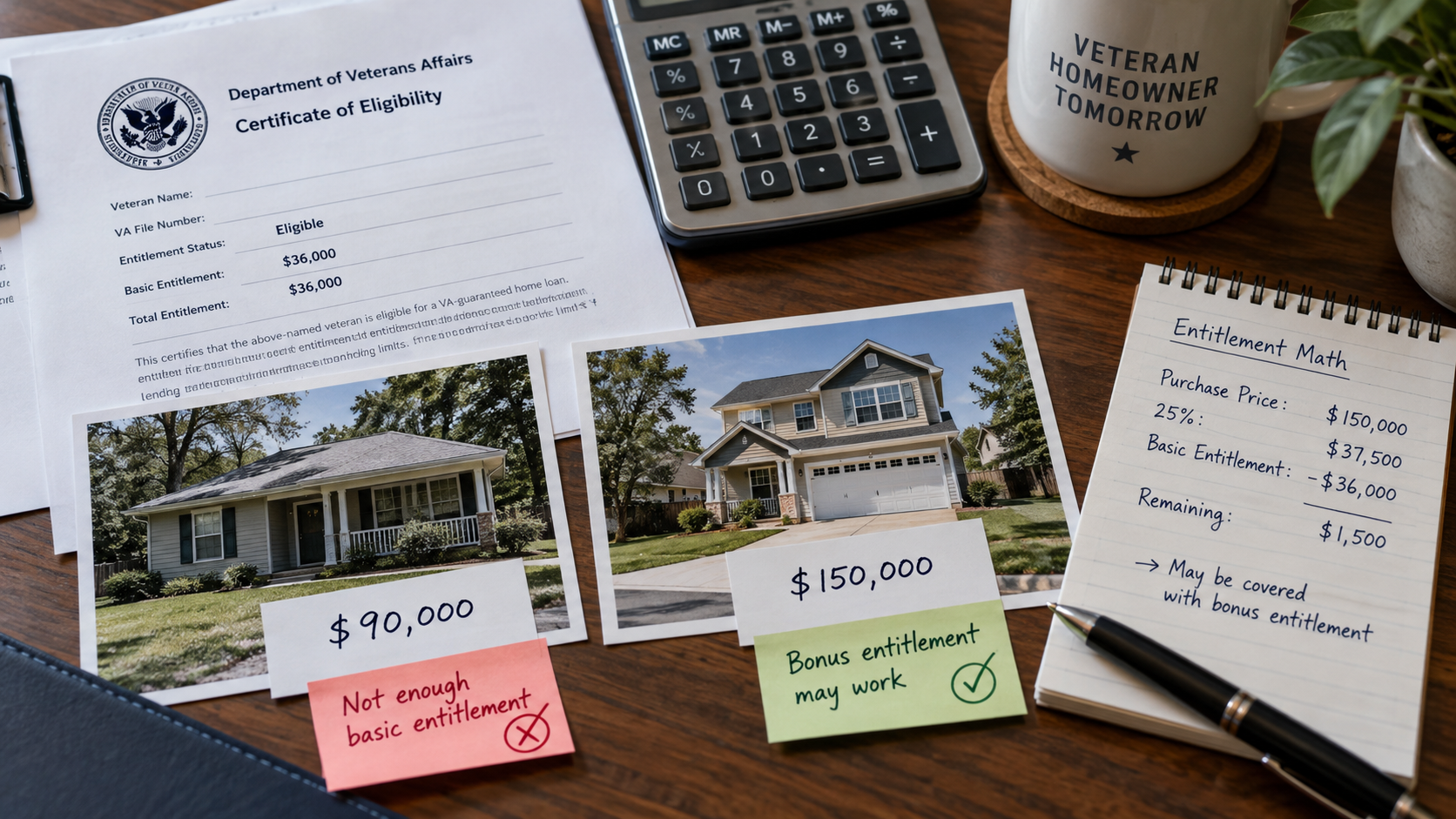
VA Bonus Entitlement: Why a $90,000 Home Can Be Harder to Finance Than a $150,000 Home
1. The Scenario
I recently worked with a veteran who encountered an unusual problem while trying to purchase a home in Kentucky.
He already owned a home in another state with an active VA loan. He also owned a property here in Kentucky that he was preparing to sell.
He found another home in Kentucky for just $90,000 and wanted to use his remaining VA loan benefits to purchase it.
At first glance, it seemed like a straightforward transaction. He had used his VA benefits before, and this time he was purchasing a relatively inexpensive home. You might reasonably assume that financing a $90,000 property would be easier than financing one costing $150,000.
But that’s not necessarily how VA entitlement works.
When I reviewed his Certificate of Eligibility, I discovered that the amount of entitlement already committed to his existing VA mortgage created an unexpected problem.
Under the VA’s entitlement calculations, he couldn’t obtain the VA guaranty needed for the smaller loan, even though a larger loan might have qualified for additional guaranty through bonus entitlement.
It sounds backward, doesn’t it?
The explanation comes down to an often-overlooked distinction between basic VA entitlement and bonus entitlement, particularly the significance of the $144,000 loan threshold.
2. The Hidden Issue
The buyer didn’t do anything wrong. The problem was an unusual VA entitlement rule that isn’t widely understood, even within the mortgage industry.
His Certificate of Eligibility (COE) showed that $38,000 of his VA entitlement was already committed to his existing mortgage. That detail made all the difference.
To understand why, you first need to understand how VA loan guarantees work.
VA guarantees a portion of a mortgage to protect the lender against loss if the borrower defaults. Generally, lenders want the VA guaranty, a down payment, or a combination of the two to cover at least 25% of the loan amount.
Every eligible veteran starts with $36,000 in what’s called basic entitlement. Here’s where the $144,000 number comes from:
$36,000 ÷ 25% = $144,000
In other words, $36,000 in basic entitlement represents 25% of a $144,000 loan.
For VA loans of $144,000 or less, the amount of basic entitlement available is calculated by subtracting entitlement already used from that original $36,000.
In this veteran’s case:
$36,000 basic entitlement − $38,000 already used = $0 remaining basic entitlement.
Because he had no basic entitlement remaining, VA couldn’t provide a guaranty for the proposed $90,000 loan under the rules governing loans of $144,000 or less.
But here’s where things get interesting.
For VA loans greater than $144,000, an entirely different entitlement calculation applies.
Instead of being limited to the original $36,000, VA calculates the veteran’s available bonus entitlement using 25% of the applicable county conforming loan limit, minus the entitlement already committed to other VA loans.
That means a veteran can have no basic entitlement remaining but still have enough bonus entitlement to obtain another VA loan above $144,000.
The result? This veteran could potentially use his remaining VA entitlement to finance a $150,000 home, even though VA couldn’t guarantee the $90,000 loan.
It’s counterintuitive, but that’s how the two entitlement calculations work. The difference isn’t that VA prefers more expensive homes. It’s that the guaranty calculation changes once the proposed loan amount exceeds $144,000.
Of course, sufficient entitlement doesn’t guarantee loan approval. The borrower must still meet the applicable credit, income, occupancy, and property requirements.
3. The Operational Fix
When we reviewed the veteran’s Certificate of Eligibility, we recognized the problem. His remaining VA entitlement wasn’t sufficient to support the $90,000 loan under the rules for smaller VA mortgages.
But that didn’t mean he needed to abandon the purchase or start shopping for a more expensive home.
Instead, we looked at his entire financial situation and considered other financing options.
The veteran was already in the process of selling another property he owned in Kentucky. That presented an opportunity to structure the purchase differently.
We recommended switching to an FHA loan, which doesn’t depend on VA entitlement and allows eligible borrowers to purchase a home with a relatively small down payment.
The proceeds from selling his Kentucky property provided the required down payment, while negotiated seller concessions helped cover his allowable closing costs.
The FHA loan closed successfully, and the veteran purchased the $90,000 home he originally wanted.
He didn’t need to buy a more expensive property or wait until his existing VA entitlement was restored. We simply found a financing solution that worked for his circumstances.
The important lesson is that the best mortgage solution isn’t always the loan program you originally intended to use. Sometimes the answer is recognizing when a different program makes more sense.
4. The Lesson Learned
The lesson from this transaction isn’t that VA loans are bad for inexpensive homes. For many veterans, a VA loan can be an excellent financing option regardless of the home’s price.
The problem arises when a veteran has already used part of their VA entitlement and doesn’t have enough remaining basic entitlement to support another smaller loan.
That’s why reviewing a veteran’s Certificate of Eligibility is so important, particularly when they already have an outstanding VA mortgage. Knowing how much entitlement has been used, how much remains, and which guaranty calculation applies can make the difference between identifying a problem early and discovering it after a purchase contract has been signed.
In this case, the veteran didn’t need a more expensive home. He needed a different financing solution. By recognizing the entitlement limitation and switching to FHA financing, we were able to close on the $90,000 property he actually wanted.
The takeaway: Before assuming you can use your VA loan benefits again, have your loan officer review your remaining entitlement and the amount you intend to borrow. A little research upfront can prevent a frustrating surprise later.
Frequently Asked Questions: VA Tier 2 Bonus Entitlement
What is VA Tier 2 or Bonus Entitlement?
VA bonus entitlement, also called second-tier or Tier 2 entitlement, is the additional VA loan guaranty available for loans exceeding $144,000.
Every eligible veteran starts with $36,000 in basic entitlement. For larger loans, VA uses an additional guaranty calculation. Veterans who have already used some of their entitlement may still have bonus entitlement available, potentially allowing them to purchase another primary residence using their VA loan benefits.
The amount available depends on how much entitlement has already been used and the applicable county conforming loan limit.
Why does the $144,000 loan amount matter for VA Bonus Entitlement?
The $144,000 threshold determines which VA entitlement calculation applies.
For loans of $144,000 or less, VA calculates the available guaranty using the veteran’s $36,000 basic entitlement, reduced by any entitlement already used and not restored.
For loans exceeding $144,000, VA uses a different calculation that may provide additional guaranty through bonus entitlement.
This doesn’t mean every veteran must purchase a home costing more than $144,000 to use a VA loan. The issue arises when a veteran has insufficient basic entitlement remaining to support a smaller loan.
In our example, the veteran had $38,000 in entitlement already committed to another VA mortgage. That left him with no basic entitlement available to guarantee the proposed $90,000 loan, even though he potentially had bonus entitlement available for a larger loan.
Can a veteran have two active VA loans at the same time?
Yes. Veterans can sometimes have two active VA loans simultaneously, provided they have sufficient remaining entitlement and meet the applicable lending and occupancy requirements.
For example, a veteran relocating to another state may keep a home financed with an existing VA loan and use remaining entitlement to purchase a new primary residence.
However, having two VA loans doesn’t mean VA benefits can be used to purchase a vacation home or an investment property without meeting the program’s occupancy requirements.
The important questions are how much entitlement remains available, whether the proposed loan can receive sufficient VA guaranty, and whether the borrower qualifies for the new mortgage.
If you’re unsure how much VA entitlement you have remaining or whether a property qualifies under your current entitlement situation, contact Musketeer Mortgage for a personalized review of your eligibility and financing options.
Call us Directly
Text us for a Quick Response